
Bernalillo County City Directory Collections
Albuquerque is the principal directory center for Bernalillo County research. The City’s history-resources page reports Albuquerque City Directories from 1908 to the present at the Albuquerque Public Library Main and the UNM Center for Southwest Research. That is a holding statement, not a title-by-title promise of a complete annual run. A dated volume, an older business directory, and the Special Collections shelves each answer slightly different questions, so record the exact publication and year used.
| Collection | Years | Where Held | Access |
|---|---|---|---|
| Albuquerque City Directories | 1908 to present, reported holding | Albuquerque Public Library Main and UNM Center for Southwest Research | Use the City history-resources route and local collection access |
| Albuquerque Business Directory | 1883 | Digitized primary volume | Online at Internet Archive |
| Hudspeth’s Albuquerque city directory | Verified 1944 volume; selected years surfaced from 1931 to 1957 | FamilySearch digital library listing | Check each listed volume individually |
| Special Collections and Genealogy Center | Current collection, no finite run claimed | Albuquerque Bernalillo County Library | Digital collection and local research access |
| Albuquerque Progress | 1934 to 1965 | Library Local History Index | 297 digitized issues |
The collection map supports careful gaps rather than assumptions. The researched sources do not publish a verified complete list of every publisher transition or every missing year. A volume found for 1944 does not prove that the same publisher issued every surrounding year. Ask the holding institution about a particular title, then preserve a citation or scan of the volume’s cover and abbreviation key.
The City history-resources page is a practical starting point for the reported directory holdings and related map routes.
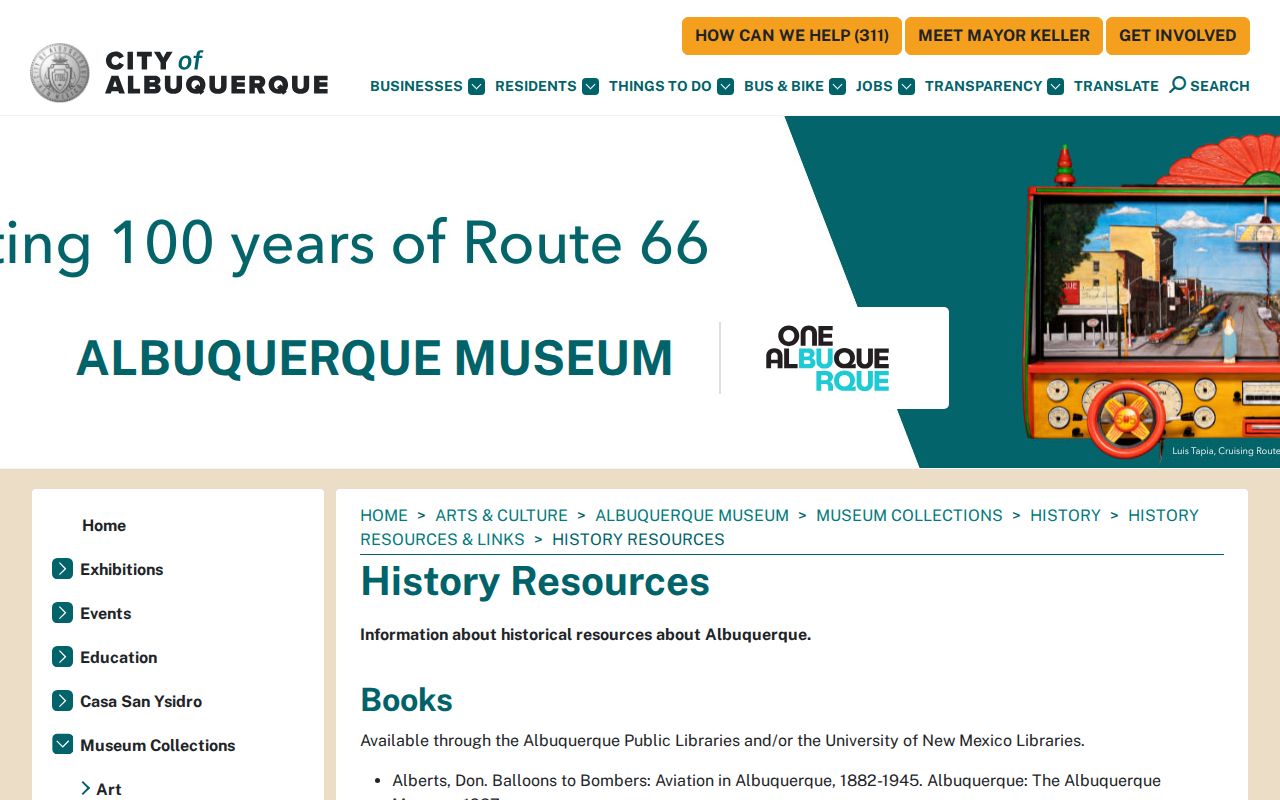
That source connects the directory shelf with Special Collections, genealogy resources, Sanborn microfilm at UNM MAGIC, and historical aerial research, which helps keep a name entry tied to its time and address.
Bernalillo County City Directory Shelves
The Albuquerque Bernalillo County Library’s Special Collections and Genealogy Center is more than a run of bound directories. Its digital-collection landing area identifies city directories, phone books, neighborhood plans and studies, plus historic street and topographic maps. The second-floor Genealogy Center adds census material, obituaries, family histories, church material, Spanish, Mexican, and Territorial archives, and yearbooks. Those companion sources can test whether a matching name and address belong to the same person.
Collection access has more than one channel. The Special Collections digital collection provides an online starting point, while the physical research shelves supply material that may not be represented by a general web search. UNM’s Center for Southwest Research and Special Collections adds manuscripts, maps, oral histories, land-grant material, and New Mexico Archives Online finding aids. Confirm reading-room and copy rules with the repository before a visit.
The library digital-collection landing page shows the local Special Collections route.
Use a directory name as one dated observation, then look for a map, obituary, yearbook, or local-history item that supplies a matching date, place, or relationship.
1883 Albuquerque City Directory Evidence
The 1883 Albuquerque Business Directory, published by Armijo Brothers & Borradaile through the Daily Journal Steam Printing House, predates the later city-directory series. It is still a strong early clue. Its alphabetic entries can combine surname and given name with an occupation, employer or firm, a work location, a residence or boarding location, and additions such as Highland Addition. These details can anchor a person or address during Albuquerque’s railroad-era growth.
Read the 1883 volume as a business directory, not as a later annual city directory with assumed symbols or coverage. It is not a complete roster for every address, and it does not establish a later volume’s abbreviation practices. The useful approach is to copy the words exactly, including corners, ranges, firm names, and additions, then compare them with a dated map or a later record.
The digitized 1883 business directory provides the primary-volume view.
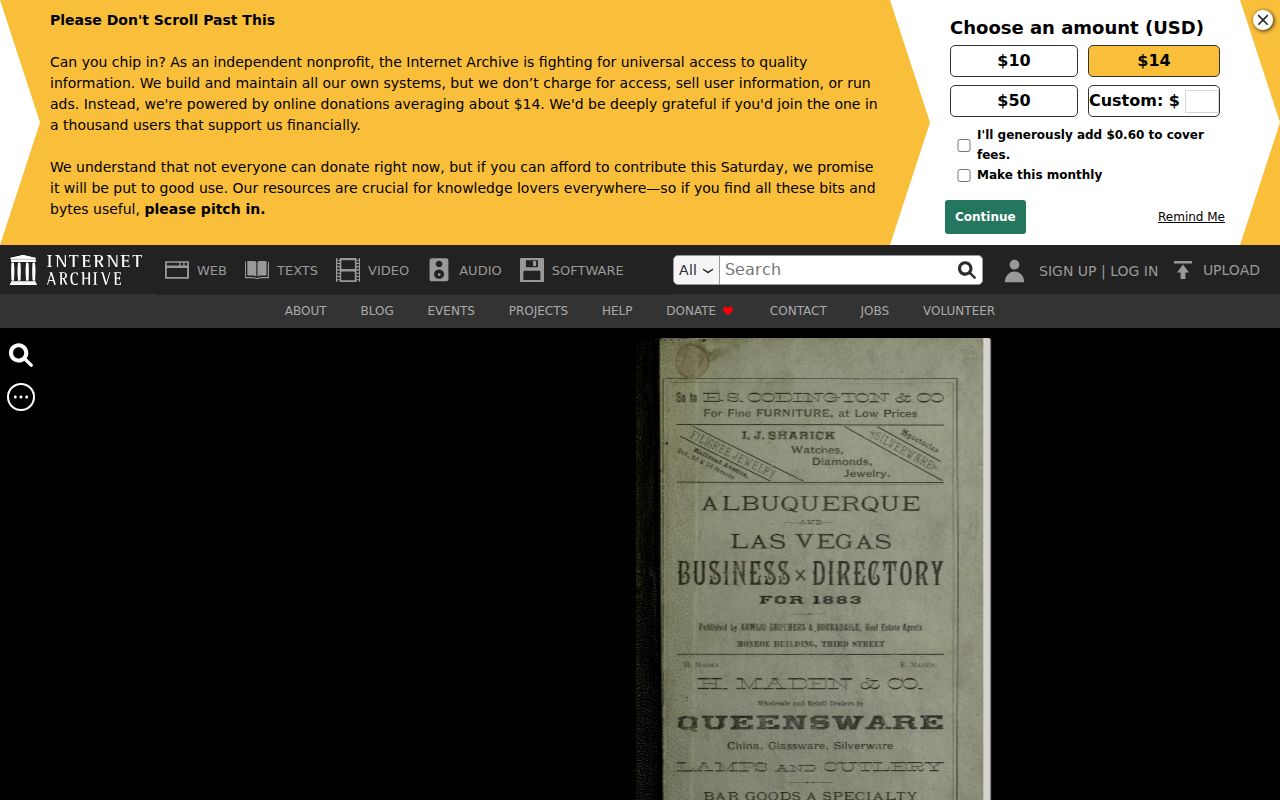
The image is a reminder to preserve the entry’s original wording instead of modernizing an old street or addition name too soon.
A verified 1944 Hudspeth directory listing supplies a separate mid-century route.
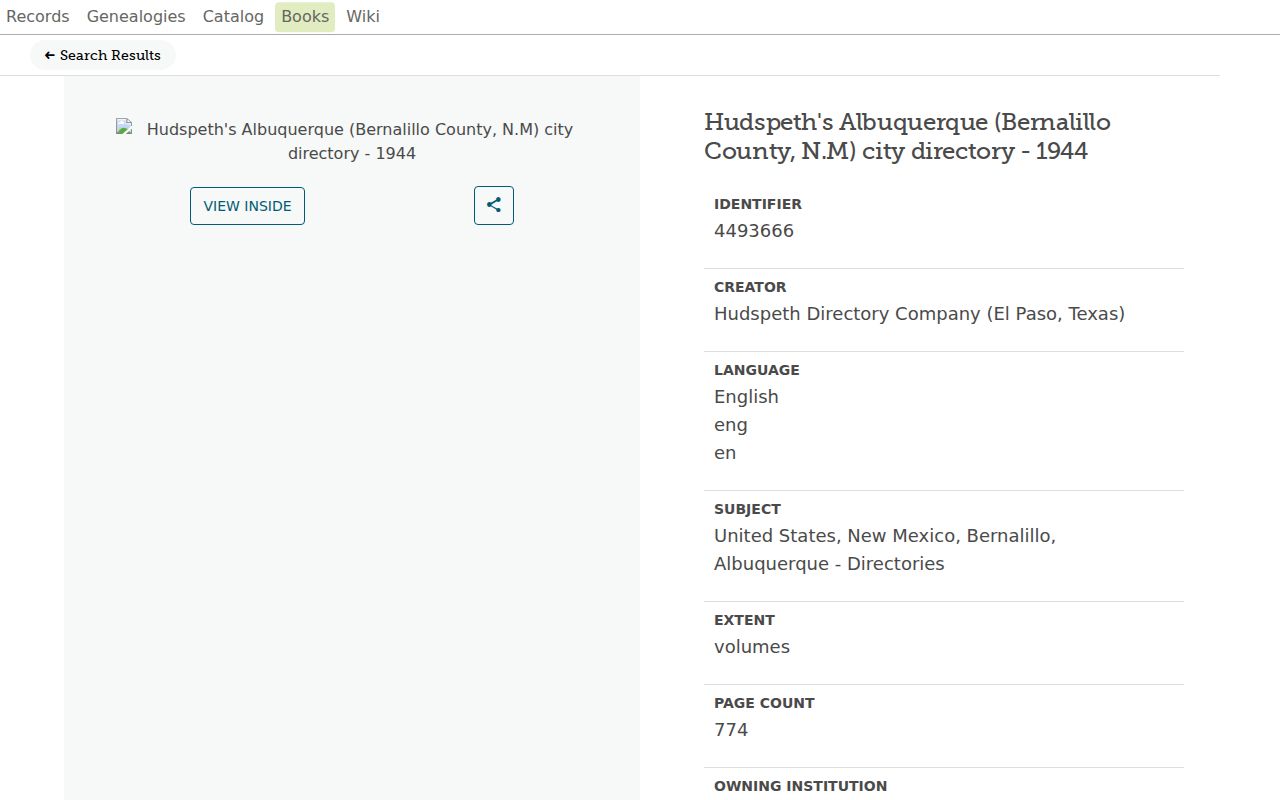
FamilySearch search results also surface selected Hudspeth years, including 1931, 1935, 1938, 1942 through 1946, 1949, 1953 through 1954, and 1957, but each result should be checked as an individual volume rather than treated as a complete run.
Bernalillo County City Directory Context
A directory usually names a person or place in one short line. The Library Local History Index adds neighborhood and building context through Albuquerque Progress. It holds 297 digitized issues from 1934 through 1965. The pre-1934 through 1947 index captures properties by street address, builder, and owner, which can provide a separate lead after a directory entry identifies a street or addition.
That distinction matters. An address index, directory, and property-related item may all describe the same block without proving the same household at the same moment. Match the publication date and the named street form before joining records. The library’s Local History Index is the source for the digitized issues and address-based access.
The Albuquerque Progress Local History Index is useful when a city directory address needs a dated neighborhood or building lead.
Its 297 digitized issues make the index a useful complement to, rather than a replacement for, the dated directory volume.
Read a Bernalillo County City Directory Entry
A city directory entry is an inventory of what the publisher supplied for a particular person, firm, or place. In the inspected 1883 business directory, a reader may see a surname and given name, an organizational or firm relation, occupation or employer, work location, residence or boarding place, and local place vocabulary such as a corner, range, or addition. Later volumes can have different layouts, so photograph or note the abbreviation key in the exact volume being used.
| Identity | Surname and given name, sometimes paired with a firm or organizational relation. |
|---|---|
| Work context | Occupation, employer or firm, and a business location, corner, or range where supplied. |
| Residence context | A residence or boarding location only when the entry provides one. |
| Place vocabulary | Street, corner, range, and addition names that should be copied exactly. |
| What it cannot settle | Everyone present at an address, a continuous stay between volumes, or an unlisted person’s location. |
- Criss-cross directory
- A later directory’s street-order section, if that volume includes one. It is a street aid, not proof that every household was listed.
- Householder index
- A name-oriented list of household entries when included by a particular publisher. Check the volume’s own layout before relying on it.
- Abbreviation key
- The volume’s explanation of its shortened terms and marks. Capture it first because conventions change from one publication to another.
City Directory Streets After 1952
Historic address searching in Albuquerque needs a second check for street change. A City historical study records that roughly 650 streets were renamed on July 1, 1952, when the four-quadrant system was adopted. Railroad Avenue had already become Central in 1912. A city directory entry with an older street form or no quadrant may describe the same physical area as a newer record, but the match should be tested rather than assumed.
- Search the directory using the street wording and quadrant printed in its own year.
- Search the historical form and the modern form when a later record is needed.
- Compare an addition or subdivision, corner, legal description, or a dated map before joining the entries.
- Keep the two forms in a research log instead of replacing the older address with a modern label.
The City Code’s grid places Central Avenue between north and south and the Santa Fe Railway tracks between east and west. That rule helps orient a modern address, but it does not erase earlier wording. The City historical study documents the street-change chronology.
| Date | Directory-research landmark |
|---|---|
| 1883 | The Armijo Brothers & Borradaile business directory records names, firms, work places, residences or boarding places, and additions. |
| 1908 | The City reports Albuquerque City Directories from this year forward as a library and UNM holding. |
| July 1, 1952 | About 650 street names changed and Albuquerque adopted four quadrants, creating a key historical-address comparison point. |
| FY 2025 | State Archives reported a discovery migration that may affect older catalog paths for related archival material. |
Trace Households With Bernalillo County City Directories
For family history, use a city directory to build a sequence of dated observations, not a continuous biography. Start with the volume closest to the target year and transcribe the entry, including an addition, corner, occupation or firm, and whether a residence is stated. Follow the surname and address in earlier and later available volumes, including spelling and two-surname variants. A change may reflect a move, a different listing choice, a changed street name, or a different person with the same name.
- Choose the annual or biennial directory closest to the date and record the entry exactly.
- Check earlier and later available volumes for the same surname, address, firm, and variant spellings.
- Pair the address with the relevant assessor roll, abstract-title collection, Clerk legal description, permit-by-street-name record, or Sanborn map for its own date range.
- Use the nearest released federal census as a separate observation. The 1950 census is the newest public individual census at the research date, and the State Records Center and Archives holds historic census microfilm.
- Extend or close a lead with an obituary, cemetery, church, probate, yearbook, newspaper, or archive source only when its name, address, and date corroborate the entry.
For a more recent address-keyed record trail, the Bernalillo County street directory uses current property, map, and recorded-document channels. A directory disappearance can mean a move, death, changed listing practice, or no listing at all. It is a reason to look for another dated source, not a reason to fill the interval by inference.
Bernalillo County Directory Archives Change
Archive routes can change even when the underlying material remains useful. The State Records Center and Archives FY 2025 report records 13,539 online descriptions added, retirement of HERITAGE, and migration of 10,189 digital objects to New Mexico Digital Collections. An old directory note or catalog citation may therefore point to a changed discovery path. Search the current catalog and ask reference staff to interpret an older call number or finding aid.
Newspapers and archival sources provide an additional access path. The library’s local guide identifies Digital Sanborn Maps and NewspaperARCHIVE Library Edition, which includes New Mexico newspapers from 1847 to 2019. The Archdiocese of Santa Fe Archives handles qualifying sacramental and vital research roughly from 1700 to about 1956, subject to its person, fee, and lead-time conditions; Catholic cemetery records have a separate searchable route. None of these collections is a complete civil roster, but a dated match can strengthen a directory lead.
Note: Collection migration can change a catalog path, so preserve the title, year, institution, and original citation when a historical directory result is found.